


You’ve been there. You finally crawl into bed after a long day, pull the covers up, and within minutes that sharp, radiating pain shoots down your leg. Or maybe it’s the tingling that wakes you at 2 a.m. — that pins-and-needles sensation that won’t quit no matter how you shift your weight.
A pinched nerve in your back doesn’t care that you’re exhausted. It doesn’t respect your sleep schedule. And if you’re sleeping in the wrong position, you’re making it worse every single night.
At Connecticut Advanced Spine, we frequently treat patients whose pain worsens at night because of poor sleeping positions for a pinched nerve. Many arrive after trying new mattresses, pillows, or over-the-counter remedies without lasting relief. In many cases, the biggest issue isn’t the bed—it’s how the body is positioned during sleep. Choosing the right sleeping positions for a pinched nerve can help reduce pressure on the affected nerve, ease discomfort, and improve the quality of your sleep.
Here’s what most people miss. A pinched nerve happens when surrounding tissue — bone, cartilage, muscle, or tendon — puts pressure on a nerve root. When you sleep, you’re in one position for hours. If that position increases pressure on an already irritated nerve, you’re essentially compressing it for six to eight hours straight. No amount of ibuprofen fixes that.
This isn’t about buying expensive gear or doing complex stretches before bed. It’s about understanding which positions decompress your spine, which ones make things worse, and how to set up your sleep environment so your back can actually heal overnight instead of deteriorating further.

Why Your Current Sleeping Position Might Be Making Your Pinched Nerve Worse
Most people sleep the same way they’ve always slept. That’s fine when your spine is healthy. When you’ve got a pinched nerve in your back, habit becomes your enemy.
Sleeping on your stomach forces your neck into rotation for hours and flattens the natural curve of your lower back. If you’ve got lumbar nerve root compression — say, from a herniated disc at L4-L5 or L5-S1 — this position pushes your vertebrae closer together and increases pressure right where you need relief. We’ve had patients come to our Bristol clinic who didn’t realize they were waking up in more pain than when they went to bed specifically because of this.
Sleeping flat on your back without support creates a similar problem. Your lower back loses its natural lordotic curve, and if you’ve got spinal stenosis or a bulging disc, that flattening can pinch the nerve even more. You might think lying flat is neutral, but it’s not. Your spine has curves for a reason.
Here’s the thing most people don’t connect: if you’re waking up stiff, numb, or in more pain than you had during the day, your sleeping position is actively working against your recovery. It’s not just discomfort. It’s re-injury, every single night.
Step 1: Start With Side Sleeping and a Pillow Between Your Knees
This is the single most effective sleeping positions for a pinched nerve in the lower back. Side sleeping with a pillow between your knees keeps your pelvis level and prevents your spine from rotating.
Here’s how to do it right. Lie on your side — ideally the side opposite your pain if you have sciatica radiating down one leg. Bend your knees slightly, as if you’re in a relaxed fetal position. Place a firm pillow between your knees and ideally another between your ankles. The goal is to keep your top leg from pulling your pelvis down and twisting your lumbar spine.
The pillow matters. Not a flat one. You need something thick enough to keep your knees separated and your hips aligned. A memory foam knee pillow works well, but a standard bed pillow folded in half does the job too.
What to watch for: if you wake up with your top leg flopped forward and the pillow on the floor, your body is reverting to old patterns. Try a longer body pillow you can hug — it keeps your top arm and leg from rolling forward and dragging your spine with them.
Some patients tell us this position feels awkward at first. That’s normal. You’re breaking a habit your body has reinforced for years. Give it three to five nights before you decide it doesn’t work. Most people notice less nerve pain and better sleep quality within a week.
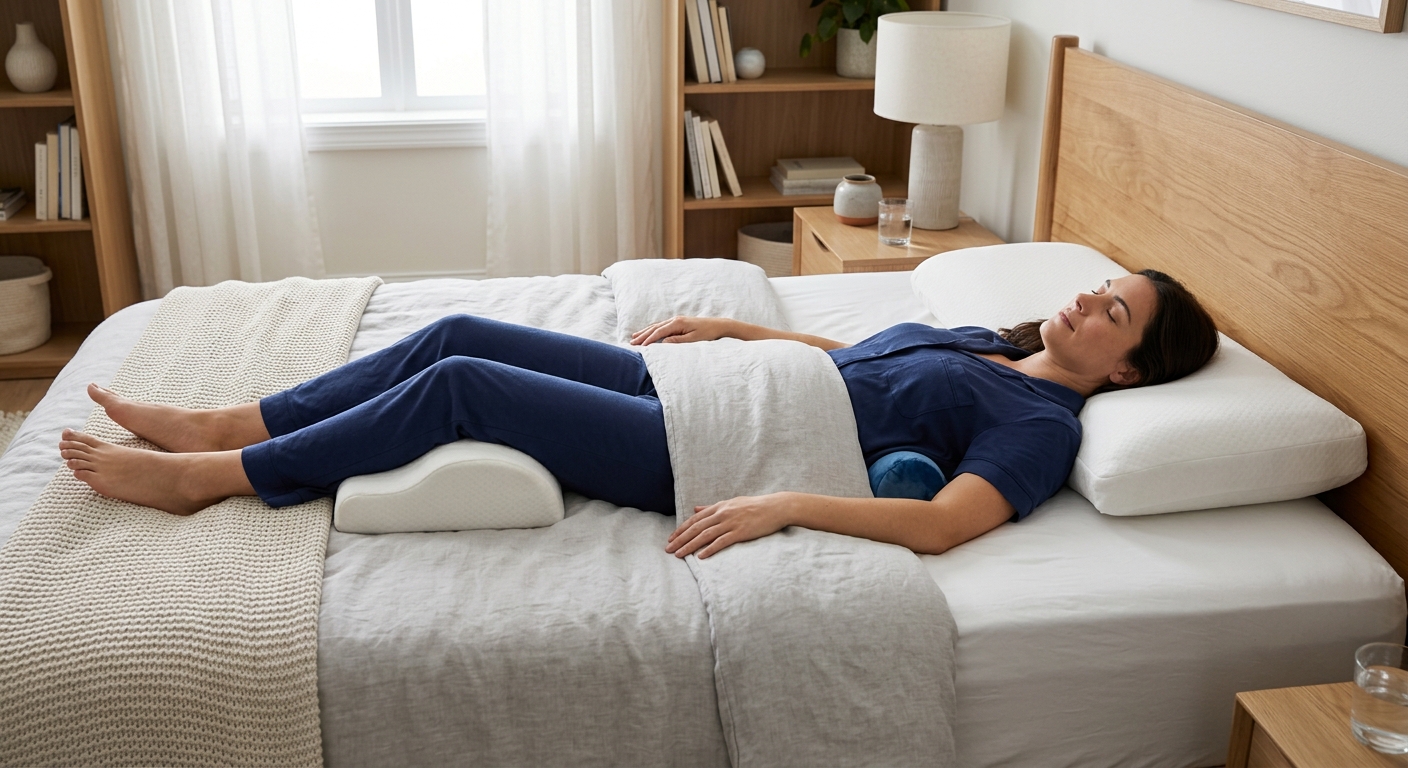
Step 2: If You Must Sleep on Your Back, Support Your Lower Spine Properly
Sleeping on your back can work for a pinched nerve, but only if you restore the natural curve of your lower back. Without support, your lumbar spine flattens against the mattress and compresses the nerve roots.
Place a pillow under your knees. This simple adjustment tilts your pelvis slightly and maintains the curve in your lower back. The pillow should be thick enough to lift your knees a few inches — a flat decorative pillow won’t cut it.
For even better support, add a small rolled towel or lumbar roll under the small of your back. This keeps your spine in a more neutral position and takes pressure off the affected nerve. You don’t need anything fancy. A bath towel rolled to about the diameter of your forearm works perfectly.
What to watch for: if you wake up with your knees flat and the pillow kicked to the side, try a wedge pillow designed to stay under your legs, or use a firmer pillow your legs can’t easily push away. Also check your mattress — if it’s old and sagging, even perfect pillow placement won’t help. A too-soft mattress lets your hips sink and throws off your alignment all over again.
One mistake we see often at Connecticut Advanced Spine: people use a pillow that’s too thick under their head when sleeping on their back. Your neck should be supported, but your head shouldn’t be propped up at a steep angle. That creates tension in your cervical spine and can contribute to nerve pain that radiates into your upper back or arms.
Step 3: Avoid Stomach Sleeping — Or Modify It If You Can’t Break the Habit
Stomach sleeping is the worst position for a pinched nerve in your back. It forces your neck into rotation for hours, flattens your lumbar curve, and creates uneven pressure on your spine.
If you can stop, stop. But we know some people physically can’t fall asleep any other way. If that’s you, here’s how to make it less damaging.
Place a flat pillow under your pelvis and lower abdomen. This prevents your lower back from hyperextending and reduces pressure on your lumbar nerve roots. Use a very thin pillow under your head, or skip the head pillow entirely. The less your neck has to rotate, the better.
Alternate which side you turn your head toward throughout the night if you wake up. Rotating to the same side every night creates asymmetric strain on your cervical spine and can contribute to pinched nerves in your neck and upper back.
What to watch for: if you’re waking up with facial numbness, jaw pain, or tingling in your arms, your neck position is likely the problem. That’s your body telling you stomach sleeping isn’t sustainable, and it’s time to retrain yourself into a side-sleeping position. The transition takes effort, but the payoff is real.
Step 4: Adjust Your Pillow to Keep Your Neck and Spine Aligned
Your head pillow is more important than you think. If your neck is angled too high or too low, you’re creating a kink in your spine that can affect nerve compression all the way down to your lower back.
For side sleepers, your pillow should fill the space between your head and the mattress so your neck stays in line with the rest of your spine. If you’ve got broad shoulders, you need a thicker pillow. Narrow shoulders need a thinner one. Stand in front of a mirror, place the pillow on your shoulder, and tilt your head onto it — your ear should align with your shoulder, not tilt up or down.
For back sleepers, your pillow should support the natural curve of your neck without pushing your head too far forward. A cervical pillow with a roll under your neck works well, but a standard medium-loft pillow folded slightly often does the job.
What to watch for: if you’re waking up with neck stiffness, headaches, or numbness in your hands, your pillow height is likely wrong. Dr. Ashish Upadhyay at Connecticut Advanced Spine often recommends patients bring their pillow to their appointment so we can assess whether it’s contributing to their symptoms. You’d be surprised how many people are using a pillow that’s completely wrong for their body.
One more thing: replace your pillow every 18 to 24 months. Pillows compress and lose support over time, and an old pillow won’t hold your alignment no matter how good it was when new.

Step 5: Use Strategic Pillow Placement to Prevent Rolling Onto Problem Positions
Even if you start the night in a good position, you might roll into a bad one by 3 a.m. Your body moves during sleep — that’s normal. But if you’ve got a pinched nerve, certain movements re-injure you before you’ve had a chance to heal.
If you’re training yourself out of stomach sleeping, place a body pillow or large cushion in front of you when lying on your side. It’s a physical barrier that keeps you from rolling forward. Sounds simple, almost silly. It works.
If you tend to roll onto your back and kick the knee pillow off, try a wedge pillow designed to stay under your legs, or wear loose shorts with pockets and tuck a tennis ball into the back pocket. Old-school trick, but it discourages back-sleeping if that’s a problem position for you.
What to watch for: if you’re waking up in the same bad position every night despite using pillows, your mattress might be too soft or too firm. A mattress that’s too soft lets you sink into problem positions. A mattress that’s too firm creates pressure points that make you shift constantly, and you’ll unconsciously move into whatever position relieves that pressure — even if it’s terrible for your nerve.
Step 6: Time Your Position Changes to Manage Pain Through the Night
Here’s something most people don’t think about. If you’re waking up in pain every night, you can use those wake-ups strategically instead of just suffering through them.
When you wake up with nerve pain, assess your position before you move. Are you twisted? Is your pillow gone? Are you on your stomach? Make the correction deliberately — side position, pillow between knees, neck aligned — instead of just flopping around until you find something comfortable.
If the pain is severe and position changes aren’t helping, get up for five to ten minutes. Walk slowly around your bedroom or down the hall. Gentle movement decompresses your spine and can reduce acute nerve pain enough that you can fall back asleep in a better position. Staying in bed and thrashing around just increases your frustration and keeps your nervous system on high alert.
What to watch for: if you’re waking up every hour in pain no matter what position you’re in, that’s a sign your pinched nerve needs more than positional changes. That’s when you need to come in and talk to us at Connecticut Advanced Spine. We can assess whether the nerve compression requires spinal injections, physical therapy, or another intervention to calm things down enough that sleep position changes can actually help.

When Sleeping Positions Aren’t Enough and You Need Professional Care
Let’s be honest. Changing your sleeping position helps most people with a pinched nerve in the back. But it doesn’t fix everyone.
If you’ve tried side sleeping with proper pillow support for two weeks and you’re still waking up in pain, or if the pain is getting worse instead of better, something else is going on. You might have significant nerve root compression from a herniated disc, spinal stenosis, or another structural problem that won’t resolve with positional changes alone.
Warning signs that you need to see a spine specialist: pain that radiates all the way down to your foot, weakness in your leg, numbness in your groin or saddle area, loss of bowel or bladder control, or pain that’s progressively getting worse over days or weeks. These aren’t things you wait out or treat with better sleep hygiene.
At Connecticut Advanced Spine in Bristol, Dr. Ashish Upadhyay specializes in diagnosing exactly what’s causing your nerve compression and tailoring treatment to the severity of your condition. For some patients, that’s physical therapy and anti-inflammatory medications. For others, it’s spinal injections to reduce inflammation around the nerve root. And for cases where conservative treatment hasn’t worked, minimally-invasive spine surgery can decompress the nerve and give you lasting relief.
We’ve worked with hundreds of patients who came in exhausted and frustrated after months of poor sleep. Most respond well to conservative treatment combined with the positional strategies in this article. But some need more, and there’s no shame in that. Nerves don’t care about effort — they respond to decompression, whether that comes from a pillow or a procedure.
Frequently Asked Questions
What is the best sleeping positions for a pinched nerve in the lower back?
Side sleeping with a pillow between your knees is the most effective position for most people with a pinched nerve in the lumbar spine. This position keeps your pelvis level, reduces spinal rotation, and takes pressure off compressed nerve roots. Choose the side opposite your radiating pain if you have sciatica.
Can sleeping on your stomach make a pinched nerve worse?
Yes. Stomach sleeping flattens the natural curve of your lower back and forces your neck into rotation for hours, which increases pressure on nerve roots in both the lumbar and cervical spine. If you can’t break the habit, place a flat pillow under your pelvis and use a very thin pillow under your head to reduce strain.
How long does it take for sleeping position changes to help a pinched nerve?
Most people notice improvement within three to five nights of consistent positional changes. If you’re not seeing any reduction in pain or improvement in sleep quality after two weeks, the nerve compression likely needs professional evaluation and treatment beyond positional adjustments.
Should I sleep with a pillow under my knees if I have a pinched nerve?
If you sleep on your back, yes. A pillow under your knees tilts your pelvis slightly and maintains the natural curve in your lower back, which reduces pressure on lumbar nerve roots. For side sleepers, the pillow goes between your knees instead, serving the same purpose of keeping your spine aligned and your pelvis level.
Get Real Relief for Your Pinched Nerve at Connecticut Advanced Spine
Changing how you sleep can make a real difference when you’re dealing with a pinched nerve in your back. But if you’ve been struggling for weeks, if the pain is interfering with work or daily life, or if you’re just tired of waking up in pain every night — it’s time to get a proper diagnosis and a treatment plan that actually addresses what’s causing your symptoms.
Dr. Ashish Upadhyay at Connecticut Advanced Spine brings fellowship-trained spine expertise and a patient-centered approach to every case. We don’t just treat pain. We find the underlying cause and build a personalized treatment plan that fits your life, your goals, and the severity of your condition.
Call our Bristol office today or visit us at Middle Street to schedule an evaluation. You don’t have to keep suffering through sleepless nights. Let’s fix the problem, not just manage the symptoms.