

Most people who walk into my Bristol office have been living with their neck for months before they call anyone. Sometimes years. They’ve tried a new pillow, a heating pad, a few YouTube stretches, and a neighbor’s advice. Cervical spine problems are rarely dramatic at the start, and that’s exactly why they get ignored.
I’m Dr. Ashish Upadhyay, a board-certified orthopedic surgeon with fellowship training in spine surgery. I came back to practice in Bristol, and at Connecticut Advanced Spine I hear the same beliefs repeated almost word for word. Some of them are harmless. A few cost people real time, and occasionally real nerve function.
So let’s go through four of them.

Myth 1: “It’s Just a Stiff Neck. It’ll Go Away on Its Own.”
Often it does. That’s what makes this myth so sticky. Most short episodes of neck pain are muscle or ligament strains that settle within a few weeks, and I’d never tell you to rush to a surgeon over one bad morning.
The trouble is the word “often.” Neck pain causes fall on a wide spectrum, and the same symptom, a tight, aching neck, can come from a strained trapezius or from a disc pressing on a nerve root. You can’t tell which from the inside.
Here’s the thing: the pattern matters more than the pain. A strain usually has a clear trigger, like a long drive, a weekend of painting a ceiling, or a bad sleep position. It improves in a fairly predictable way. Cervical spine problems tend to behave differently. They flare for no obvious reason, they come back in the same spot, and they bring company. Pain that travels into the shoulder blade or arm. A hand that goes numb while you’re holding a phone. Headaches that start at the base of the skull.
The common neck pain causes I see in practice include:
- Muscle and ligament strain from posture, lifting, or sudden movement
- Age-related wear in the discs and joints, often called cervical spondylosis
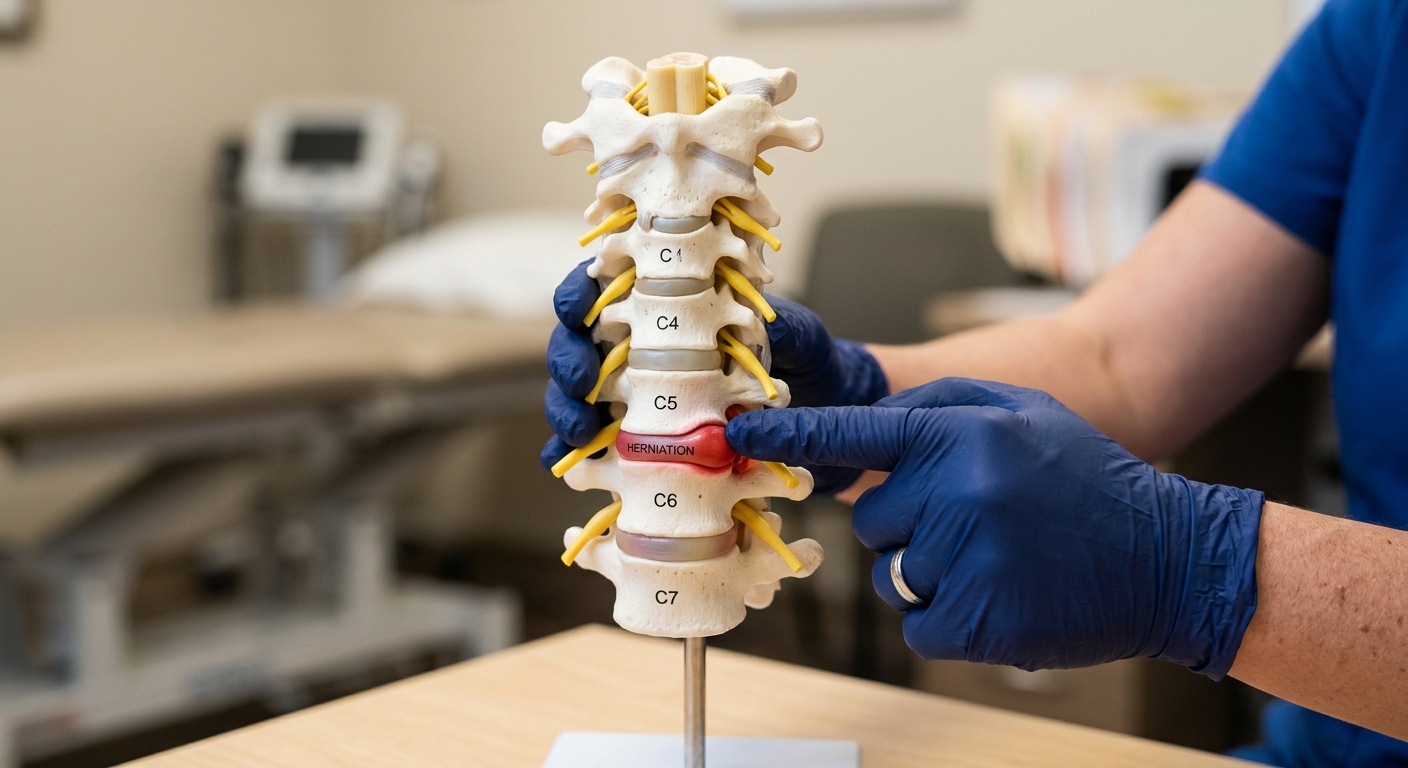
- A herniated disc in the neck pressing on a nerve
- Narrowing of the spinal canal (cervical stenosis)
- Injury, including whiplash from car accidents
- Less often, things outside the spine entirely, like shoulder problems that refer pain upward
A realistic rule of thumb: if your neck pain hasn’t clearly improved after about four to six weeks of sensible self-care, get it examined. And if you have arm weakness, hand clumsiness, or trouble with balance, don’t wait that long. Those aren’t stiff-neck symptoms.
What to do next: for the next week, write down where the pain goes, what makes it worse, and what time of day it peaks. That small log is worth more to a spine specialist than you’d expect. I’ve had patients hand me a phone note that cut our first visit’s guesswork in half.
Myth 2: “Pain Down My Arm Means I Need Surgery”
It doesn’t. Cervical radiculopathy, the medical name for a pinched or irritated nerve root in the neck, is one of the most misunderstood cervical spine problems, and most people who have it never need an operation.
Radiculopathy happens when a nerve leaving the spinal cord gets compressed or inflamed. A herniated disc in the neck is a classic cause. Bone spurs are another. The nerve then sends signals along its whole path, so the problem is in your neck but you feel it in your triceps, your forearm, or your thumb and index finger. Which finger tingles actually tells us roughly which level of the spine is involved. It’s a little like tracing a fault in a wiring panel by seeing which room’s lights are flickering.
Now the part that surprises people. According to the [American Academy of Orthopaedic Surgeons’ OrthoInfo](https://orthoinfo.aaos.org), the majority of patients with this kind of nerve irritation improve with nonsurgical care. That matches what I see. The usual first steps are time, activity changes, physical therapy, anti-inflammatory medication when appropriate, and sometimes a targeted spinal injection to calm the nerve root down.
Cervical radiculopathy treatment is a ladder, not a trapdoor. You start on the bottom rung and move up only if you need to.
When surgery for cervical spine problems becomes a real conversation
I start talking about surgery when one of these is true:
- Weakness is showing up, such as a grip that’s failing or an arm that tires abnormally fast
- Pain isn’t controlled after a fair trial of conservative care, usually some weeks
- Imaging shows clear compression that matches your symptoms
- There are signs the spinal cord itself, not just a nerve root, is being squeezed
That third point deserves a flag. Imaging that doesn’t match symptoms is a trap. I’ve seen MRIs with dramatic findings in people who feel fine, and mild-looking scans in people in real misery. We treat the patient, not the picture.
What to do next: if you have arm symptoms, ask whoever examines you a simple question. “Is this a nerve root problem or a spinal cord problem?” The answer changes how urgent things are.

Myth 3: “Cervical Spondylosis Is Just Aging, So There’s Nothing to Do”
Cervical spondylosis is age-related wear, but “nothing to do” is wrong. Wear in the neck is common, usually manageable, and sometimes the hidden driver behind a lot of other symptoms.
By middle age, most of us have some degree of disc drying, narrowing, and small bone spurs in the neck. Studies of people without any symptoms show a lot of this on scans, which is why I hesitate when a patient says, “My X-ray says arthritis, so that’s that.” The label describes what’s there. It doesn’t predict how you’ll feel.
What cervical spondylosis symptoms look like in real life varies a lot. Some people get a dull, grinding stiffness that’s worse in the morning. Some get headaches that start behind the head. Some have a crackling sensation when they turn. Others feel nothing until a bony spur narrows the canal and the spinal cord gets involved, which is called cervical myelopathy.
Myelopathy is the one I don’t want you to miss. It rarely hurts much. Instead it shows up as clumsy hands, trouble with buttons or handwriting, a feeling of walking on unsteady ground, or dropping things. Patients and families often blame it on getting older. The [National Institute of Neurological Disorders and Stroke](https://www.ninds.nih.gov) describes spinal cord compression as a condition that can progress, and early evaluation matters because lost function doesn’t always come back fully.
Contrarian but true: pain is not the best warning sign in the neck. Function is. A stiff, achy neck that still lets you do everything is a different conversation from a painless neck attached to hands that have gotten awkward.
So what actually helps when wear is the cause? Usually this:
- Physical therapy aimed at deep neck stabilizers, not just stretching
- Workstation changes, since monitor height is a bigger deal than most people think
- Anti-inflammatory strategies your physician approves
- Spinal injections when inflammation around a nerve is driving the pain
- Weight-bearing exercise and bone health checks, since osteoporosis can sit quietly in the background
Here’s a pattern from our clinic: a lot of patients in their fifties come in after years of desk work, convinced the problem is their pillow. When we look closer, the posture and the way they hold their head while typing are doing far more damage than any mattress. Pillow swaps didn’t help them. A better setup and a few months of focused therapy did.
What to do next: check your screen height and your head position right now. If your chin is poking forward as you read this, that’s the first adjustment.
Myth 4: “Neck Surgery Always Means Fusion and a Long, Painful Recovery”
It doesn’t. Spine surgery in the neck has changed a lot, and many cervical procedures today are done through small incisions with shorter hospital stays than patients expect. That said, recovery is real and I won’t pretend otherwise.
Let me be direct about the fear, because I understand it. The neck holds your spinal cord. Nobody wants to hear the word surgery attached to it. But what the operation is aiming for is usually straightforward: take pressure off a nerve or the spinal cord, and keep the spine stable.
Depending on the problem, that may involve removing a herniated disc and then either fusing the level or placing a motion-preserving implant. In other situations, a small decompression is enough. Minimally-invasive spine surgery techniques can mean less muscle disruption, which tends to help with early pain and getting back to normal activity. It doesn’t mean no recovery, and it isn’t right for every neck. Some conditions need a more traditional approach, and I’ll tell you honestly when that’s the case.
Spinal fusion in the neck deserves a fair word. People worry that fusing a level will leave them stiff. In practice, the neck has several levels that share the work, and most patients adapt well after a single-level fusion. The concern is real over the long term, since levels next to a fusion carry extra load, and that’s one reason surgeon selection and good indication matter so much.
Timelines I’d rather you hear from me than a brochure:
| Stage | What to realistically expect |
|—|—|
| First days | Sore throat or swallowing discomfort after front-of-neck surgery is common and usually settles |
| First few weeks | Light walking, no heavy lifting, desk work often possible for some patients sooner than others |
| Two to three months | Strength and endurance return gradually, therapy often begins |
| Several months | Fusion matures; arm symptoms may keep improving even after pain eases |
Those are general ranges. Yours depends on the procedure, your overall health, and your job.
One more thing patients don’t expect: nerve recovery is slower than pain recovery. Arm pain can ease within days or weeks after decompression, while numbness may linger for months. I tell people that up front so nobody thinks something went wrong at week three.
What to do next: if surgery is ever suggested, ask three questions. What exactly will you do to the spine? What are the non-surgical options I haven’t tried? And what happens if I wait? A good surgeon welcomes all of them.
How Do You Know It’s Time to See a Spine Specialist?
See a spine specialist if neck pain lasts beyond a month or two, if you have arm weakness or numbness, or if your hands or balance feel off. Go the same day for sudden severe weakness or loss of bladder or bowel control.
I’d rather you come in too early than too late. In our experience at Connecticut Advanced Spine, the patients who struggle most aren’t the ones who came in for a “minor” problem that turned out to be minor. They’re the ones who waited through months of progressive numbness because they assumed it was normal.
Seek urgent care for any of these:
- Sudden loss of strength in an arm or leg
- Trouble controlling your bladder or bowels
- Neck pain after significant trauma, such as a car accident or fall
- Severe neck pain with fever, or unexplained weight loss
- Difficulty walking or sudden clumsiness in both hands
For everything else, a thoughtful evaluation usually includes a careful history, a physical exam of strength, reflexes, and sensation, and then imaging like X-rays or an MRI only when it’ll change the plan. Not every sore neck needs a scan. Over-imaging creates anxiety about findings that don’t matter.
Also worth saying: this article is educational, not a diagnosis. Cervical spine problems overlap with shoulder issues, nerve entrapments in the wrist or elbow, and even heart-related pain, so a proper exam matters.
Image suggestion for this section: a spine specialist reviewing a cervical MRI with a patient. Alt text: “spine specialist explaining cervical spine problems on an MRI scan to a patient in Bristol, CT.”
Frequently Asked Questions
What are the most common cervical spine problems?
The most common are muscle strain, cervical spondylosis (age-related wear), a herniated disc in the neck, cervical radiculopathy, and spinal stenosis. Whiplash injuries also show up often after car accidents. Many people have more than one going on at once, which is why a proper exam matters more than a single label.
Can a herniated disc in the neck heal without surgery?
Yes, often. The body can reabsorb part of a herniated disc over weeks to months, and symptoms frequently improve with physical therapy, activity changes, and sometimes injections. Surgery becomes a topic when weakness appears, pain doesn’t respond to a fair trial of conservative care, or the spinal cord is being compressed.
How long does cervical radiculopathy last?
Many cases improve substantially within several weeks to a few months, though it varies by cause and severity. Arm pain usually eases before numbness does. If you have progressive weakness, or symptoms haven’t improved after a reasonable course of treatment, get re-evaluated rather than waiting.
Is cervical spondylosis serious?
Usually not. It’s common with age and often causes only stiffness or mild pain. It becomes more serious if bone spurs or disc changes squeeze the spinal cord, causing hand clumsiness or balance problems. That’s the situation where early evaluation really helps.
Get Your Neck Looked At Before It Gets Louder
If you’ve been living with a neck that’s stiff, achy, tingling, or just not right, don’t sit through another few months wondering. Cervical spine problems are far easier to manage when we catch them early, and most of the time the plan starts with simple, non-surgical steps.
I’m Dr. Ashish Upadhyay, and at Connecticut Advanced Spine on Middle Street in Bristol, we look at the cause of your symptoms, not only the symptoms themselves. Call or visit our Bristol office to book an evaluation, and bring your symptom notes and any prior imaging with you. We’ll tell you honestly what we find and what your options are, including when the answer is “you don’t need surgery.”