Your lower back’s been screaming at you for weeks. Maybe months. You’ve tried ignoring it, stretching it, heating it, and you’re still here searching for answers at 11 PM.
Here’s what I’ve learned treating patients at Connecticut Advanced Spine — most people wait way too long to figure out what’s actually wrong. They assume all lower back pain is the same. It’s not. The lumbar spine is complex, and what’s causing your neighbour’s pain might be completely different from what’s causing yours. That matters because the treatment that works for a herniated disc won’t do much for spinal stenosis.
I’m Dr. Ashish Upadhyay, and I’ve spent years training specifically in spine surgery before returning to serve the Bristol community. Every week, I see patients who’ve been managing pain they don’t fully understand. The goal here isn’t to scare you — it’s to help you recognize what you’re dealing with so you can actually do something about it.
What Makes the Lumbar Spine Different
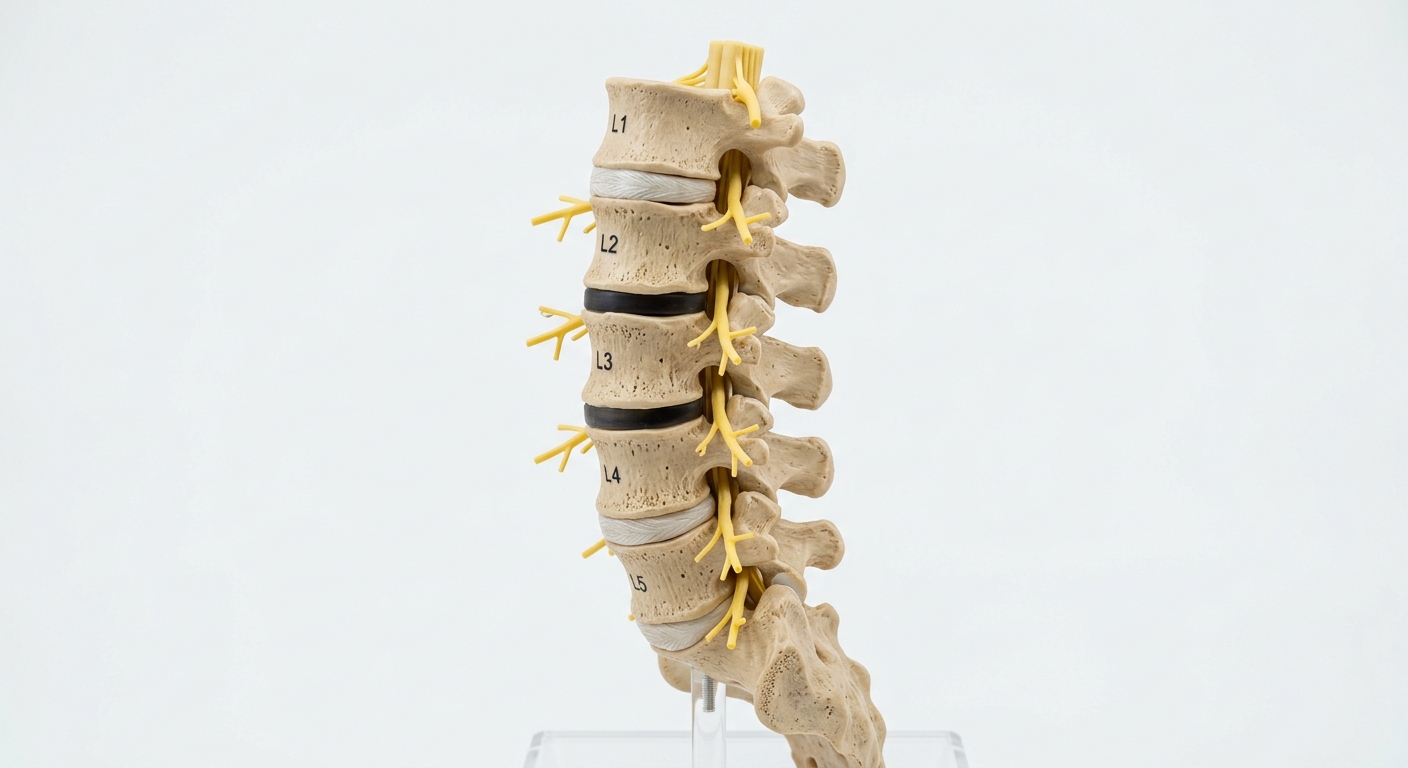
Your lumbar spine — that’s the lower five vertebrae in your back, labelled L1 through L5 — carries more weight than any other part of your spine. Literally. Every time you bend, lift, twist, or just sit poorly at your desk, those five bones and the discs between them are absorbing force.
The discs act like shock absorbers. They’re tough on the outside, gel-like on the inside. When they’re healthy, they work great. When they’re not, you feel it fast.
Between each vertebra, nerves exit the spinal canal and head down to your legs. That’s why lumbar spine problems don’t always stay in your back. They travel. The pain shoots down your leg, or your foot goes numb, or your calf starts tingling for no apparent reason.
Most patients don’t connect those dots at first. They think the leg pain is a separate issue. It’s not.
Herniated Discs — When the Cushion Fails
Lumbar disc herniation is one of the most common lumbar spine problems I treat. The outer layer of the disc tears, and the gel inside pushes out. Sometimes it presses directly on a nerve root.
That’s when things get miserable.
The classic presentation? Sharp pain in the lower back that radiates down one leg. You might feel numbness, tingling, or weakness. Sitting makes it worse. Coughing or sneezing sends a jolt through you. Patients describe it as electric, burning, or like someone’s jabbing a knife into their hip and thigh.
Here’s the part most people get wrong — a herniated disc doesn’t always need surgery. In fact, most don’t. Conservative treatment works for about 80 to 90 percent of cases if you stick with it. Physical therapy, anti-inflammatory medications, activity modification, sometimes spinal injections. The body can actually reabsorb some of that herniated material over time.
But if you’ve got significant weakness in your leg, or you’re losing bowel or bladder control, that’s a different story. That’s urgent. Don’t wait on that.
I had a patient last year — mid-40s, works in construction — who couldn’t lift his right foot. Foot drop, we call it. He’d been dealing with back pain for months, kept working through it. By the time he came in, the nerve had been compressed so long that even after surgery, recovery took longer than it should have. Timing matters.
Degenerative Disc Disease — The Wear and Tear Nobody Escapes
Despite the name, degenerative disc disease isn’t really a disease. It’s aging. The discs in your lumbar spine dry out over time, lose height, become less effective at cushioning. Some people feel it more than others.
You’ll hear patients say their back is “bone on bone.” That’s not quite accurate, but it captures the feeling. The pain is usually a dull ache that gets worse with activity and better with rest. It can flare up after heavy lifting or long periods of sitting.
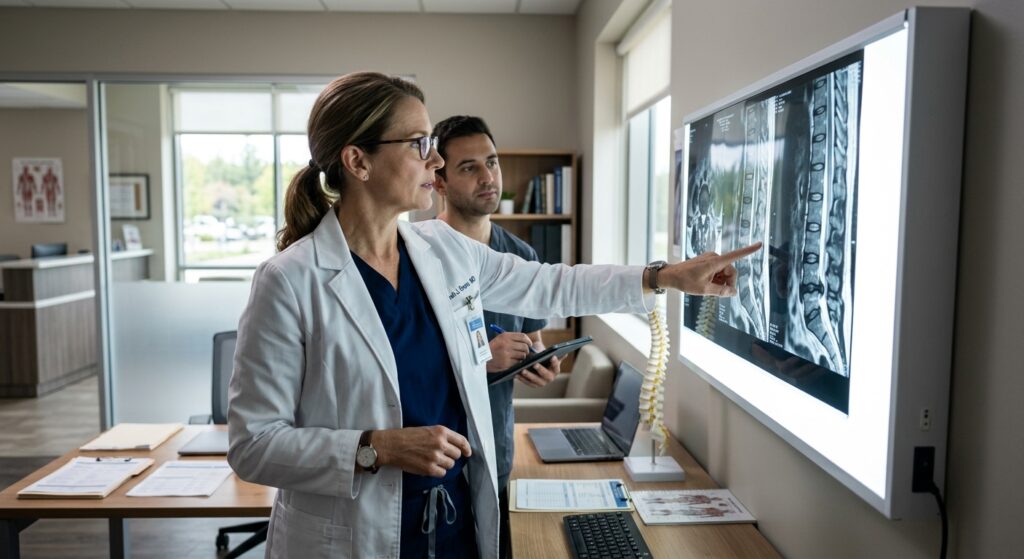
The tricky part? MRI scans show degenerative changes in almost everyone over 40. But not everyone has pain. I’ve seen scans that look terrible on film where the patient feels fine, and scans that look relatively mild where the patient is in agony. Imaging tells part of the story, not all of it.
Treatment focuses on managing symptoms. Physical therapy to strengthen the core muscles that support your spine. Weight management if that’s a factor. Anti-inflammatory medications. Sometimes injections help. Surgery is typically a last resort — spinal fusion or disc replacement — and only when conservative options have truly failed and the pain is disrupting your life.
Most people don’t need surgery for this. But they do need a plan.
Spinal Stenosis — When the Canal Narrows
Lumbar stenosis means the spinal canal is narrowing, putting pressure on the spinal cord or the nerve roots. It’s incredibly common in people over 60, though I’ve seen it earlier.
The hallmark symptom is something called neurogenic claudication. You start walking, and after a few minutes, your legs get heavy, weak, or painful. You stop, sit down, and it gets better. Then you start walking again and the cycle repeats.
Patients often tell me they can only make it halfway through the grocery store before they have to find a bench. Or they’ve started using a shopping cart not because they need it for groceries, but because leaning forward on it relieves the pressure.
That forward-leaning position opens up the spinal canal just enough to give the nerves some breathing room. It’s why people with stenosis can often ride a stationary bike without issue but can’t walk around the block.
Stenosis develops slowly. Bone spurs form, ligaments thicken, discs bulge — all of it gradually closes in on the space where your nerves sit. It’s a mechanical problem, which means the treatment often ends up being mechanical too.
Conservative treatment — physical therapy, medications, epidural steroid injections — can help manage symptoms. But if you’re losing mobility, if you can’t walk more than a block, if your quality of life has tanked, surgery becomes worth considering. Decompression surgery removes whatever’s crowding the canal. For the right patient, it works well.

Spondylolisthesis — When One Vertebra Slips Forward
Spondylolisthesis happens when one vertebra slides forward over the one below it. Usually it’s L4 slipping over L5, or L5 slipping over the sacrum.
There are different causes. Sometimes it’s a stress fracture in the back of the vertebra — common in athletes who hyperextend their spines a lot, like gymnasts or football linemen. Sometimes it’s degenerative — the joints and discs wear out and can’t hold the vertebra in place anymore.
The pain can be similar to other lumbar spine problems — lower back pain, leg pain, stiffness. What sets it apart is that it often gets worse with activity, especially extension movements like arching your back.
Diagnosis is straightforward. An X-ray shows the slip. We grade it from 1 to 4 based on how far the vertebra has moved. Most cases are grade 1 or 2, which usually respond to conservative care.
But here’s where it gets tricky. Some people have spondylolisthesis on imaging and don’t even know it. No pain, no symptoms. Others have a mild slip and significant pain. Your symptoms matter more than the grade of the slip.
Treatment starts conservatively — physical therapy focused on core stabilization, activity modification, anti-inflammatory medications. If that doesn’t work and the slip is progressing or causing nerve compression, spinal fusion might be necessary. It’s not a decision we make lightly, but when it’s the right call, it reliably stops the slipping and alleviates the pain.
Sciatica — The Symptom, Not the Diagnosis
Sciatica isn’t a condition. It’s a symptom. It means the sciatic nerve — which runs from your lower back down through your hips, buttocks, and legs — is irritated or compressed.
What’s causing it? That’s the real question. Could be a herniated disc. Could be stenosis. Could be spondylolisthesis. Could be piriformis syndrome, where a muscle deep in your buttock compresses the nerve. Could even be a tumour, though that’s rare.
The pain is distinctive. Sharp, burning, shooting down one leg. Sometimes it starts in your lower back, sometimes it starts in your buttock. It can go all the way to your foot. Numbness and tingling tag along. Weakness too, in some cases.
I’ve had patients describe it as the worst pain they’ve ever felt. Worse than childbirth, one woman told me. I believed her.
Treatment depends entirely on what’s causing it. You can’t treat sciatica effectively without knowing the underlying lumbar spine problem. That’s why I push back when patients come in asking for a quick fix. There’s no one-size-fits-all here.
Most cases improve with conservative care. Physical therapy, medications, sometimes injections. But if you’re not getting better after six weeks of consistent treatment, it’s time to dig deeper. Get imaging. Figure out exactly what’s compressing that nerve. Then treat the actual problem, not just the symptom.
Facet Joint Syndrome — The Joints That Cause Trouble
The facet joints sit at the back of each vertebra and help guide movement. When they get inflamed or arthritic — and they will with age — they cause pain.
It’s usually a deep, achy pain in the lower back. Sometimes it radiates to the buttocks or thighs, but it doesn’t usually go past the knee. That’s a key difference from sciatica. The pain gets worse with extension and twisting — movements that load the facet joints.
Patients tell me it hurts to stand for long periods, to arch backwards, to twist to check their blind spot while driving. They feel stiff in the morning. Movement helps at first, but too much makes it worse again.
Diagnosis can be tricky because facet joint pain overlaps with other lumbar spine problems. Physical exam helps. Sometimes we do a diagnostic injection — numb the joint and see if the pain goes away. If it does, we’ve found the source.
Treatment starts with physical therapy and anti-inflammatory medications. Facet joint injections can provide relief that lasts weeks or months. For chronic cases, radiofrequency ablation — where we use heat to disrupt the nerve signals from the joint — can offer longer-term relief.
Surgery isn’t usually the answer for facet pain, and I’m upfront about that. Managing it is more realistic than curing it.
How to Know When It’s Serious
Most lower back pain isn’t dangerous. It’s painful, sure. Disruptive. Frustrating. But not medically urgent.
There are exceptions.
Seek immediate care if you have any of these red flags: sudden loss of bowel or bladder control, progressive weakness in your legs, numbness in the saddle area (groin and inner thighs), severe pain after trauma like a fall or car accident, or unexplained weight loss along with back pain.
Those suggest something more serious — cauda equina syndrome, fracture, infection, or malignancy. They need immediate evaluation.
For everything else, here’s my rule of thumb. If your pain is getting better week over week, even slowly, conservative treatment is probably working. Keep going. If it’s not improving after six weeks, or if it’s getting worse despite treatment, it’s time for imaging and a deeper look.
Don’t wait six months. I see that too often. Patients tough it out, thinking it’ll resolve on its own, and by the time they come in, the problem’s worse and harder to fix.
What Actually Works for Most Lumbar Spine Problems
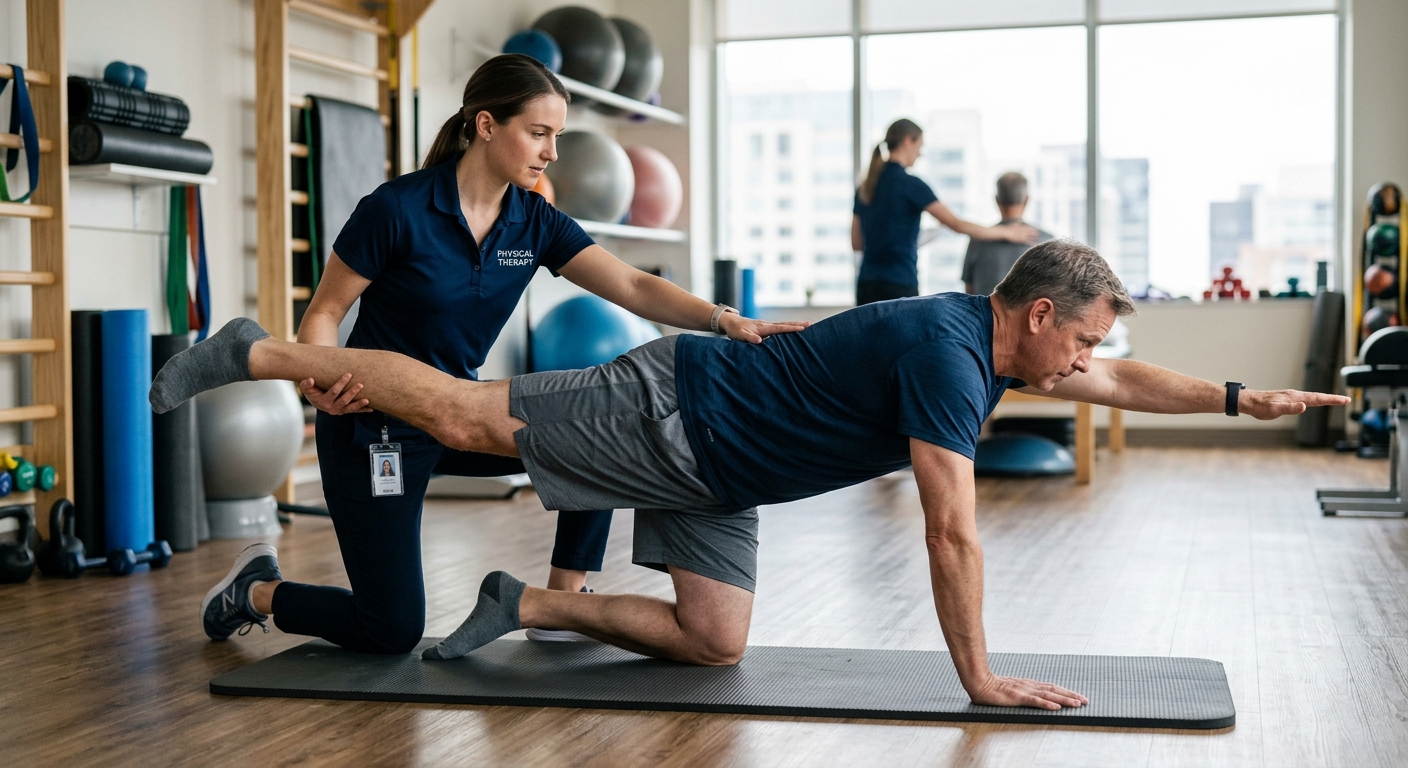
Physical therapy. Seriously. Not the “here’s a handout, do these exercises” kind. The kind where a skilled therapist actually watches how you move, identifies weak or tight areas, and builds a plan around your specific problem.
Core strengthening matters more than most people think. Your core isn’t just abs — it’s the deep stabilizing muscles around your spine. When they’re strong, they take pressure off the discs and joints.
Weight management helps too, though nobody likes hearing it. Every extra pound increases the load on your lumbar spine. Losing even 10 pounds can make a measurable difference in pain levels.
Anti-inflammatory medications — ibuprofen, naproxen — are useful for short-term flare-ups. They reduce inflammation around irritated nerves and joints. But they’re not a long-term solution. You’re managing symptoms, not fixing the underlying problem.
Epidural steroid injections can be incredibly effective for nerve-related pain. They won’t fix a herniated disc or stenosis, but they can calm down the inflammation enough for you to participate in physical therapy and let your body heal. They don’t work for everyone, and the relief is temporary, but when they work, they buy you time.
Activity modification isn’t about stopping everything. It’s about being smarter. If bending forward hurts, avoid it for a few weeks. If sitting aggravates it, take breaks. You’re not being lazy — you’re being strategic.
When Surgery Becomes the Right Answer
Surgery is never the first option at Connecticut Advanced Spine. But it’s not the last resort either. It’s the right option when conservative treatment has genuinely failed and your quality of life is suffering.
What does “failed” mean? At least six weeks of consistent conservative care — physical therapy, medications, injections — with no meaningful improvement. Or progressive neurological symptoms like worsening weakness.
The most common procedures for lumbar spine problems are decompression (removing bone or disc material that’s pressing on nerves) and fusion (stabilizing vertebrae that are moving too much or slipping). Minimally-invasive techniques mean smaller incisions, less muscle damage, faster recovery.
I tell patients this: surgery fixes the structural problem. It takes pressure off the nerve, stabilizes the unstable segment, removes the source of compression. But it’s not magic. You’ll still need physical therapy afterwards. You’ll still need to take care of your spine.
And here’s the honest part — surgery has risks. Infection, bleeding, nerve damage, the possibility that it doesn’t fully resolve your pain. Those risks are low in experienced hands, but they’re not zero. You need to know that going in.
The patients who do best are the ones with a clear structural problem that matches their symptoms. A herniated disc pressing on a nerve. Stenosis causing leg pain when walking. Spondylolisthesis with instability. When imaging and symptoms line up, surgery outcomes are generally very good.
Why We Focus on Root Causes, Not Just Symptoms
You can mask pain. You can take medications, get injections, adjust your life around it. But if you’re not addressing what’s actually causing the lumbar spine problem, you’re just kicking the can down the road.
At Connecticut Advanced Spine, we don’t treat MRI scans. We treat people. That means looking at the whole picture — your symptoms, your imaging, your lifestyle, your goals. A 30-year-old labourer with a herniated disc has different needs than a 70-year-old retiree with stenosis. The treatment plan needs to reflect that.
We also don’t rush to surgery. Some clinics do. It’s faster, it’s more profitable, and patients sometimes even ask for it because they’re desperate for relief. But surgery doesn’t undo years of poor mechanics or weak core muscles. If those aren’t addressed, you’re at risk for problems at other levels of your spine down the road.
The goal isn’t just to get you out of pain. It’s to get you functioning again — working, exercising, sleeping, living without your back dictating what you can and can’t do.
Frequently Asked Questions
What is the most common lumbar spine problem causing lower back pain?
Herniated discs and degenerative disc disease are the most common lumbar spine problems causing lower back pain, especially in adults between 30 and 60. Both involve the discs between your vertebrae and can press on nearby nerves or cause inflammation.
Can lumbar spine problems heal on their own without surgery?
Yes. Most lumbar spine problems improve with conservative treatment — physical therapy, medications, activity modification, and sometimes injections. Surgery is only necessary when conservative care fails or when there’s significant nerve compression causing progressive weakness.
How do I know if my lower back pain is serious?
Seek immediate medical attention if you experience loss of bowel or bladder control, progressive leg weakness, saddle numbness, severe pain after trauma, or unexplained weight loss with back pain. For other pain, if it’s not improving after six weeks of treatment, get evaluated.
What’s the difference between sciatica and other lumbar spine problems?
Sciatica is a symptom, not a diagnosis. It describes pain that radiates down your leg along the sciatic nerve. It’s caused by underlying lumbar spine problems like herniated discs, stenosis, or spondylolisthesis. Treatment depends on identifying the root cause.
Get a Clear Diagnosis and a Real Treatment Plan
Lower back pain isn’t something you should just live with. And you shouldn’t be guessing about what’s causing it.
At Connecticut Advanced Spine, Dr. Ashish Upadhyay provides comprehensive evaluations for all types of lumbar spine problems. We use advanced imaging, physical examination, and a patient-centered approach to figure out exactly what’s going on and build a treatment plan that actually fits your life.
Whether you’re dealing with a herniated disc, spinal stenosis, sciatica, or degenerative changes, we’ll start with conservative options and only consider surgery if it’s truly the right move.
Located on Middle Street in Bristol, CT, we serve the local community with specialized spine care that’s both advanced and accessible. Call us to schedule a consultation and stop wondering what’s wrong with your back.